Warm introductions
Warm introductions vs cold outbound: what the numbers say
Warm intro sales vs cold outbound vs referrals in B2B: what the data says about reply rates, close rates and deal size, and when each approach makes sense.
Pierce Brehm6 min read
Most salespeople will tell you a warm introduction beats a cold email. Ask them by how much and the answers get vague, and the numbers people do quote come from very different places. I've spent a lot of years on the warm side of this, so I'm biased, and the fair thing seemed to be looking at what's actually been measured and being clear about where the data stops being useful.
What counts as a warm introduction?
A warm introduction is when someone who knows both of you connects you, usually by email, and says why a conversation is worth having. The introducer's name is doing the work. Noticing a shared connection on LinkedIn and mentioning it in your pitch is something else, and I'd call it warm context. It helps a little, but nobody has vouched for you. Cold outbound is everything left over: a message to someone with no relationship to you and nobody's recommendation behind it.
These three behave differently, and a lot of the confusion in the statistics comes from people lumping them together.
What cold outbound numbers look like
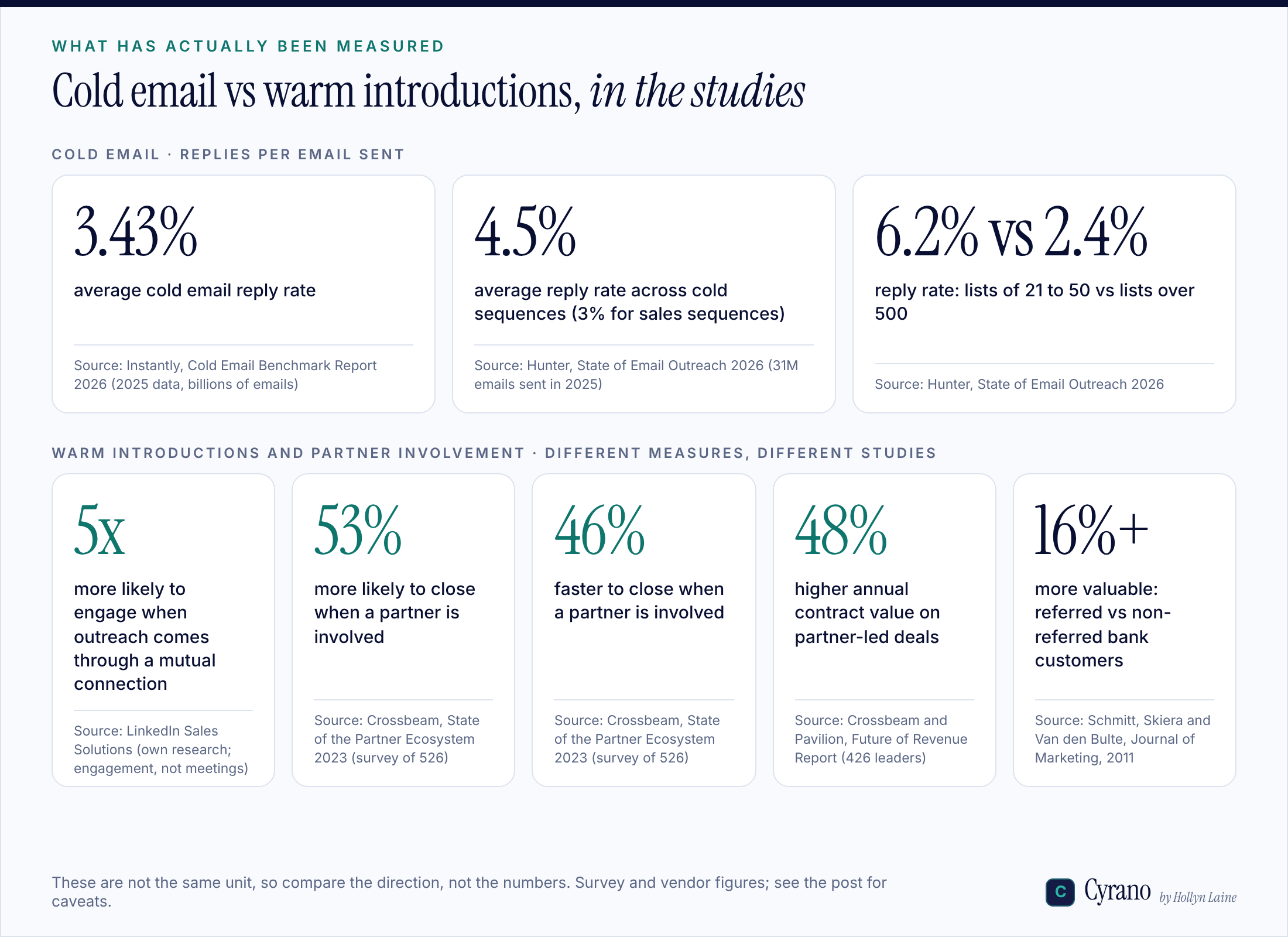
Cold email is the easiest channel to measure, so there's plenty of data. Instantly analyzed billions of cold email interactions from 2025 and found an average reply rate of 3.43%, with the top 10% of senders above 10%. Hunter's 2026 report, built on 31 million emails, put the average at 4.5% and sales-focused sequences at 3%. Both companies sell cold email tools, so keep that in mind, but their numbers land in the same neighborhood.
Two details matter here. A reply isn't a meeting, and Hunter points out that most of the replies people get are negative. So 1,000 emails at those rates gets you somewhere between 34 and 45 replies, and a smaller number of conversations worth having. Targeting also makes a big difference. Hunter found that sequences sent to 21 to 50 people got a 6.2% reply rate, compared with 2.4% for sequences sent to more than 500. Careful cold outreach can still work, but it gets harder as the list gets bigger and less relevant.
What the warm introduction numbers say
There's no clean benchmark comparing warm-intro meetings with cold-email meetings in the same market. What we have is several related pieces of evidence that point the same direction.
LinkedIn's sales team says buyers are 5x more likely to engage when the outreach comes through a mutual connection. That's LinkedIn's own research, the post doesn't spell out the method, and it measures engagement rather than meetings or deals.
In Crossbeam's 2023 State of the Partner Ecosystem report, 526 partnership professionals reported that deals were on average 53% more likely to close and closed 46% faster when a partner was involved. A separate Crossbeam and Pavilion survey of 426 revenue leaders, the Future of Revenue Report, found that ecosystem-led deals, meaning deals that involve partners, had a 48% higher annual contract value.
Going further back, a Journal of Marketing study that followed about 10,000 customers of a German bank found referred customers were worth at least 16% more than comparable customers who weren't referred.
What these numbers don't tell you
Lined up like that, it looks like a blowout. I still wouldn't build a plan on that picture, for a few reasons.
The numbers measure different things. Reply rate per email, engagement, close likelihood, contract size and customer value aren't the same unit, and nobody has put them in one study. Most are also self-reported averages or come from vendors. Crossbeam's figures come from surveys, the LinkedIn figure comes from LinkedIn, and the cold email benchmarks come from companies that sell outreach software.
Partner-involved deals may simply be better deals, too. A partner is more likely to get involved when the account is a good fit and the buyer is already interested, so some of that 53% is probably selection rather than the partner. And partner involvement covers more than introductions, since it includes co-selling and sharing account intel, so I wouldn't read 53% as the lift from one warm intro.
Even Crossbeam's two surveys land in different places. The Future of Revenue Report put the close-rate lift at 49% and the speed-up at 31%, against 53% and 46% in the 2023 report. What I take from all of it is the direction, which is consistent across very different sources, and not the size.
When cold outbound is still the right call
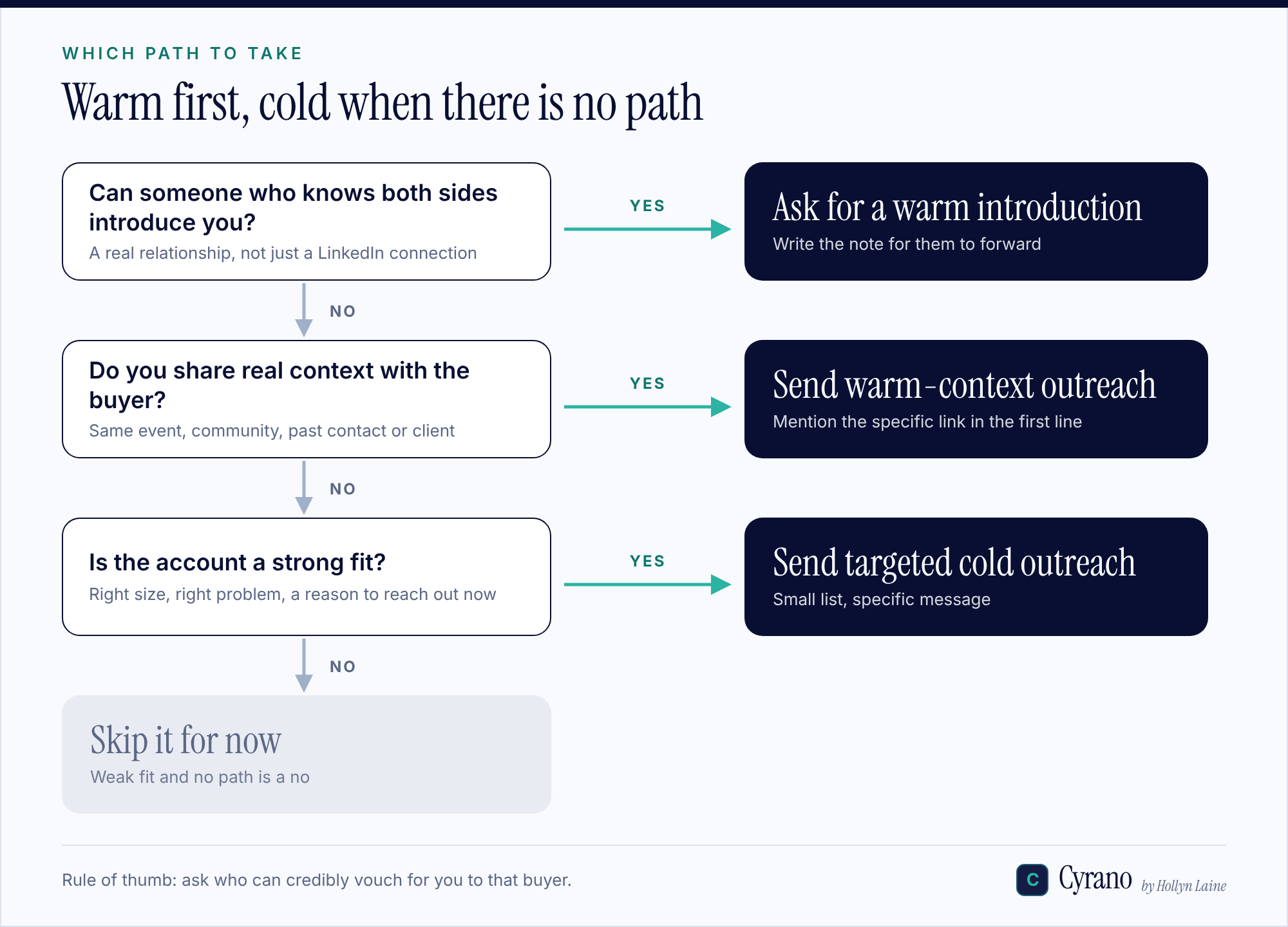
I'm a warm intro guy, and I still think cold has a place. If you're entering a market where you don't know anyone, there's nobody to ask. If you're testing a new ideal customer profile, cold is a fast way to learn which message gets traction before you ask anyone to put their name on it. And some accounts simply have nobody in your network who knows them. In all of those cases a short, specific, well-researched message to a small list is the right move, and the reply rates above say the smaller the list, the better it works.
Where I'd avoid cold by default is accounts where a warm path exists. You'd be taking the harder route to the same inbox. A quick way to decide is to ask who, if anyone, can credibly vouch for you to that buyer.
How to run warm introductions so they work
A few habits make the difference between an intro that gets a meeting and one that gets ignored.
Check how strong the connection really is. Somebody who worked closely with the buyer is worth far more than someone who accepted a LinkedIn request years ago. A weak intro can be worse than a good cold message, because it spends the introducer's goodwill and gives the buyer nothing to hold on to.
Make the ask specific and easy. Tell the introducer who you'd like to meet and why, then write the note for them to forward. LinkedIn's own guide to earning referrals recommends the same thing. When the buyer is senior, ask for their okay before the introduction goes out.
Follow up quickly, and tell the introducer what happened. Introducers who never hear the outcome tend to stop offering.
Warm introductions don't scale like cold email. You can't ask the same person for ten introductions a month, which is why who your connectors are matters so much. If you want to build that supply on purpose, I wrote a longer guide on how to find referral partners who actually send deals.
A quick note on how we do this at Hollyn Laine. We make warm introductions between B2B companies and the referral partners who already serve their buyers, using a network we've built over more than a decade, and Cyrano is the platform that helps us score fit and keep the conversations organized. If you'd like to see how it works, there's a two-minute product tour at usecyrano.ai.